


FOMC meets on 27 and 28 October: the Fed faces energy-driven inflation
A month after its first rate rise since 2023, the Fed meets with inflation at 3.7% and oil above $100. What its minutes, its projections and the markets are saying.
The Federal Open Market Committee (FOMC), the US Federal Reserve's rate-setting body, meets on 27 and 28 October 20261. On 16 September it raised its benchmark rate by a quarter of a percentage point, to a range of 3.75% to 4%, with all twelve voting members in favour2. It was the first rise since July 2023, after six cuts between September 2024 and December 20253.
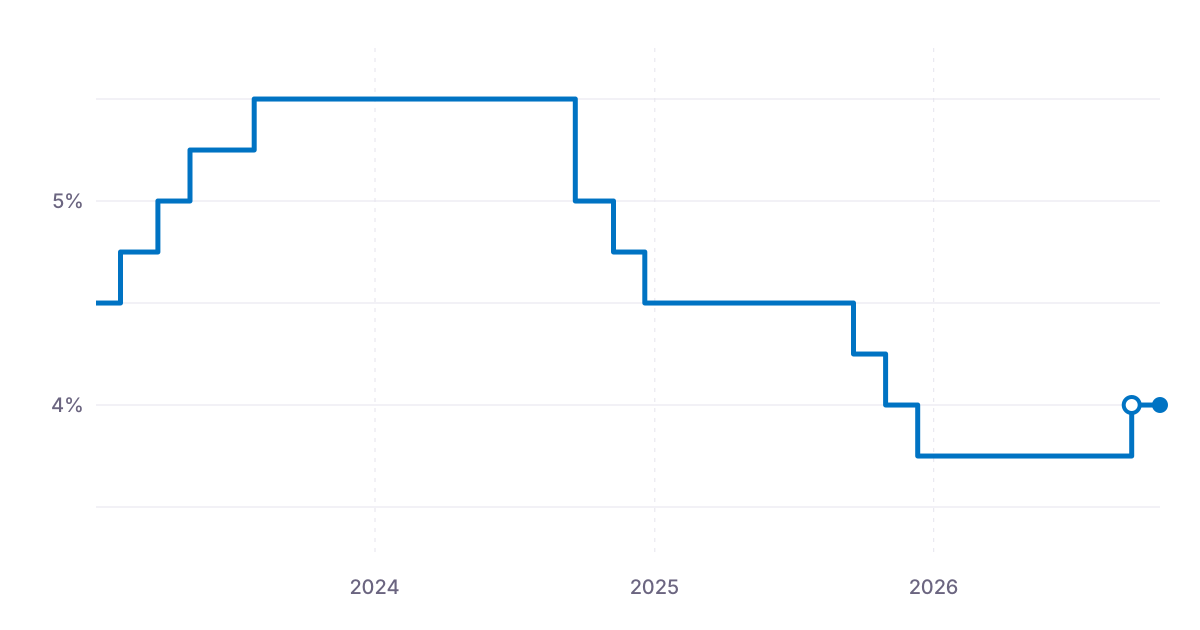
Why the Fed raised rates
The September statement described activity expanding at a solid pace, unemployment little changed and inflation that remains elevated2. The minutes of the meeting, published on 7 October, name the main cause: disruption linked to the conflict pushed up the price of crude oil and fuel, which weighs on consumer prices as well as on companies' costs, from transport to inputs4.
The figures published since then point the same way:
- Consumer prices: up 0.6% in September and 3.7% year on year. Energy rose 20.4% over the year, petrol 34.2%5.
- Excluding food and energy: up 0.3% on the month and 2.6% year on year5. Inflation is coming mainly from energy.
- Producer prices: up 1.3% in September6.
- Oil: a barrel of WTI crude was trading at $107.89 on 20 October, against $58.66 a year earlier7.
What the Fed has already signalled
According to the minutes, most participants judged that a further rise would probably be appropriate before the end of the year. They also said they would approach each meeting without any decision taken in advance, depending on the data and the balance of risks4.
The projections published in September point the same way. Their median puts the benchmark rate at 4.1% at the end of 2026, and again at 4.1% at the end of 20278. For inflation as measured by the PCE price index, they show 3.7% in 2026 and 2.3% in 2027; excluding food and energy, 3.4% and then 2.5%8.
The labour market is not pulling the other way. The minutes describe it as stable and close to full employment4. The unemployment rate was 4.2% in September, with 29,000 jobs created according to the first estimate6.
October or December?
Two meetings are left this year: October's, then the one on 8 and 9 December1. The October meeting brings no new projections: the next set arrives in December1.
In between, several releases will count9:
| Date | Release |
|---|---|
| 29 October | Third-quarter GDP, personal income and spending (September PCE inflation) |
| 6 November | October employment report |
| 10 November | October consumer prices |
What the markets are watching
The two-year US Treasury yield stood at 4.65% on 22 October and the ten-year yield at 4.96%10. The three-month Treasury bill yielded 4.22%, above the effective federal funds rate of 3.88%10, a gap that partly reflects expectations of a further rise.
Ten-year expected inflation, read from the gap between conventional Treasuries and inflation-linked ones, was 2.34% on 23 October11. The minutes had already noted that long-term expectations were holding steady, even as short-term inflation rose with oil4.
And crypto?
For an asset that pays no yield, such as bitcoin, the real rate matters: it is what a risk-free investment earns once inflation is stripped out. The ten-year real Treasury yield was 2.64% on 22 October12.
The other variable followed closely is liquidity in the financial system. Our article on the Fed's net liquidity sets out its three components and how they have changed over two years.
Sources
- Federal Reserve, FOMC meeting calendar. ↩
- Federal Reserve, FOMC statement of 16 September 2026. ↩
- Federal Reserve, history of policy rates. ↩
- Federal Reserve, minutes of the FOMC meeting of 15 and 16 September 2026, published on 7 October 2026. ↩
- Bureau of Labor Statistics, consumer price index for September 2026, 14 October 2026. ↩
- Bureau of Labor Statistics, main indicators, October 2026. ↩
- FRED, WTI crude oil price (DCOILWTICO). ↩
- Federal Reserve, economic projections of September 2026. ↩
- FRED, economic release calendar. ↩
- FRED, two-year (DGS2), ten-year (DGS10) and three-month (DGS3MO) Treasury yields and effective federal funds rate (DFF). ↩
- FRED, ten-year breakeven inflation (T10YIE). ↩
- FRED, ten-year real Treasury yield (DFII10). ↩